



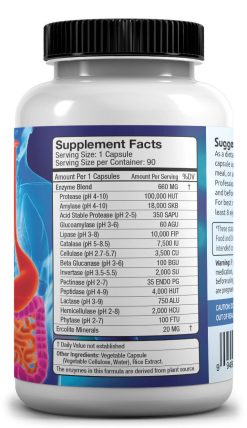


AL Series Gluten Free Digestive Enzymes
AL Series Features:
- 100% Vegetable Capsules
- GMO Free
- Vegan Enzymes
- Made in USA
- Not a Proprietary Blend
- Functional in a wide pH Range
- Gluten Free
- No Fillers
- Plant-Derived
- GMP Certified
- Mfg. in an Organically Certified Facility
Available in 90 Capsules & 270 Capsules below:
- Description
- Serving Size & Supplemental Facts
- Compare HP, MF and AL Series
- FAQs
- Celiac Disease
- Crohn's Disease
- Diverticulitis
- Irritable Bowel Syndrome
 The AL Series is fully capable of assisting in the digestion of proteins, fats, sugars, fibers, and carbs. The AL Series contains Peptidase, Beta Glucanase and Glucoamylase instead of Bromelain or Malt Diastase. The AL Series does not contain Bromelain or Papain because some people are sensitive to them because of their sources. Bromelain comes from pineapple and Papain comes from papaya. The AL Series does not contain Malt Diastase because some believe that it contains a very small amount of gluten which can cause intestinal imbalances for people with Celiac disease. Our enzymes are produced in an Organically Certified facility that is FDA inspected. Our product contains no fillers, yeast, dairy, wheat, soy, gluten or corn and is free of artificial colors, flavors and preservatives. We use the highest quality raw materials to produce superior results.
 If you eat fast food, processed food, or cooked food you may need supplemental digestive enzymes to assist in the digestion of these enzyme deficient foods. Researchers have discovered that processing or cooking food kills virtually all of the digestive enzymes that were once in it. Food enzymes are the first step in proper digestion, absorption, and assimilation of vital nutrients. Undigested food can cause many health imbalances that can lead to a variety of issues. This is a full spectrum formulation capable of aiding in the digestion of proteins, fats, carbohydrates, sugars, fibers, and dairy products.
Allegany Nutrition uses the highest quality all-natural blend of plant derived digestive enzymes available on the market today!
Do you know anyone who suffers from these?
- Heartburn
- Constipation
- Bloating
- Chronic Illness
- Diverticulitis
- Gluten Free
- Gas
- Food Allergies
- Sensitive Stomach
- Weight Loss
- Lactose Intolerance
- Energy
- Celiac Disease
- Crohn’s Disease
Serving Size & Supplemental Facts
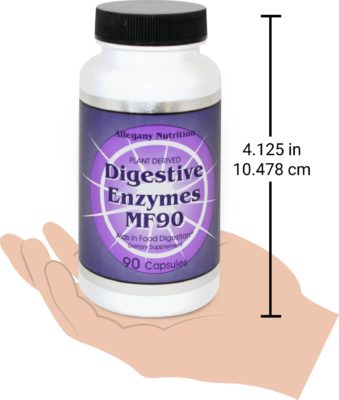
CAPSULES PER BOTTLE: 90 count bottle.
SUGGESTED SERVING SIZE: 1 Capsule Per Meal
Directions: As a dietary supplement, adults take 1 or 2 capsules at the start of each meal, or as directed by your Health Care Professional. May be taken between meals and before bed to aid in detoxification. For best results, adults should drink at least 8-eight ounce glasses of water daily.
Contains no corn, dairy, gluten, soy, sugar or fillers.
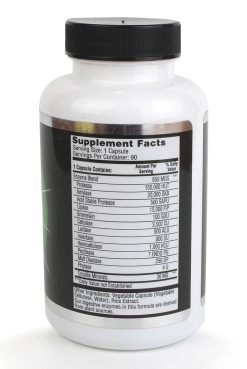
| Ingredients | Amt/1 capsule (Ingredients Per Capsule) | Function of Each Enzyme |
|---|---|---|
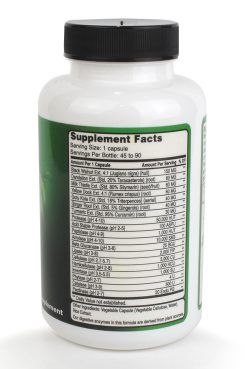
| Protease pH range is 4 to 10 | 100,000 FCC/HUT | Breaks down protein. (Beef, chicken, fish, vegetable protein) |
| Acid Stable Protease pH range is 2 to 5 | 350 FCC/SAPU | Breaks down acidic protein. (found in various meats) |
| Peptidase pH range is 4 to 9 | 4,000 HUT | Breaks down protein peptides Peptides connect amino acid chains in protein. |
| Amylase pH range is 4 to 10 | 18,000 SKB | Breaks down Carbohydrates, Starches, and Sugars. (bread, potatoes) |
| GlucoAmylase pH range is 3 to 6 | 60 FCC/AGU | Breaks down complex and simple sugars |
| Lipase pH range is 3 to 8 | 10,000 FCC/FIP | Breaks down fats and oil. (triglycerides, and other lipids) |
| Catalase pH range is 5 to 8.5 | 7,500 IU | Breaks down Hydrogen Peroxide |
| Lactase pH range is 3 to 9 | 750 FCC/ALU | Breaks down lactose. (cheese, milk, dairy products) |
| Cellulase pH range is 2.7 to 5.7 | 3,500 FCC/CU | Breaks down fibers in fruits and vegetables |
| Hemicellulase pH range is 2 to 8 | 2,000 FCC/HCU | Digests vegetables. (breaks down hemicellulose in cell walls) |
| Beta-Glucanase pH range is 3 to 56 | 100 BGU | Breaks down fiber and Celluose |
| Invertase pH range is 3.5 to 5.5 | 2,000 SU | Breaks down sugars |
| Phytase pH range is 2 to 7 | 100 FTU | Breaks down phytate which negatively binds important minerals. |
| Pectinase pH range is 2 to 7 | 35 ENDO PG | Breaks down pectin. (Pectin - important nutrient in fruits) |
| Ionic Trace Minerals | 20 MG | Increases the utilization of enzymes. |
| Other Ingredients: Vegetable Capsule (Vegetable Cellulose, Water), Rice Extract |
Compare HP, MF and AL Series
Many people ask us what the differences are between the HP, MF and AL series. Everyone responds differently to different formulations. Therefore we offer 3 unique formulas. All three enzyme formulations are fully capable of assisting in the digestion of proteins, fats, sugars, fibers, and carbs. The AL-Series contains Peptidase, Beta Glucanase and GlucoAmylase instead of Bromelain, Papain, or Malt Diastase. The AL-Series is perfect for someone looking for a good full spectrum digestive enzyme. It also works well for people with Celiac or Crohns disease and for people with sensitive stomachs. The HP-Series is an all round, very strong enzyme formulation. The MF Series is also an all round strong formulation but designed toward people who have a sensitivity to digesting dairy products.
| Enzymes Listed Below (Activity Per Capsule) | HP Series 90 / 270 Capsules per Bottle | MF Series 90 Capsules per Bottle | AL Series 90, 270 Capsules per Bottle | Function of Each Enzyme |
|---|---|---|---|---|
| Protease | 150,000 FCC/HUT | 75,000 FCC/HUT | 100,000 FCC/HUT | Breaks down protein. |
| Acid Stable Protease | 500 FCC/SAPU | 175 FCC/SAPU | 350 FCC/SAPU | Breaks down protein in an acidic environment. |
| Peptidase | - 0 - | - 0 - | 4,000 FCC/HUT | Breaks down protein peptides. |
| Bromelain | 100 GDU | 50 GDU | - 0 - | Breaks down proteins. |
| Papain | - 0 - | 300,000 PU | - 0 - | Breaks down a variety of proteins. |
| Amylase | 20,000 SKB | 12,000 SKB | 18,000 SKB | Breaks down carbohydrates, starches, and sugars. |
| Amyloglucosidase / GlucoAmylase | - 0 - | 50 AGU | 60 AGU | Breaks down complex and simple sugars. |
| Malt Diastase | 250 FCC/DP | 250 FCC/DP | - 0 - | Breaks down complex and simple sugars. |
| Lipase | 15,000 FCC/FIP | 10,000 FCC/FIP | 10,000 FCC/FIP | Breaks down fats and oils. |
| Catalase | 7500 IU / 0 IU | 0 | 7,500 IU | Converts hydrogen peroxide into water and oxygen. |
| Lactase | 500 FCC/ALU | 1,500 FCC/ALU | 750 FCC/ALU | Breaks down lactose. (Dairy products) |
| Alpha Galactosidase | - 0 - | 100 GALU | - 0 - | Breaks down carbs; raffinose, stachyose, and melibiose. |
| Beta-Glucanase | - 0 - | - 0 - | 100 BGU | Breaks down fiber and cellulose. |
| Cellulase | 3,500 FCC/CU | 1,000 FCC/CU | 3,500 FCC/CU | Breaks down fibers in fruits and vegetables. |
| Hemicellulase | 1,000 FCC/HCU | 500 FCC/HCU | 2,000 FCC/HCU | Breaks down vegetable cell walls. |
| Invertase | 800 SU | 800 SU | 2,000 SU | Breaks down table sugar. |
| Phytase | 100 FTU | 100 FTU | 100 FTU | Breaks down phytate which neg. binds minerals. |
| Pectinase | 7 ENDO PG | 3.5 ENDO PG | 35 ENDO PG | Breaks down pectin found in fruit. |
| Ionic Trace Minerals | 30 MG | 30 MG | 20 MG | Enzyme Cofactors |
| Other Ingredients: Vegetable Capsule (Vegetable Cellulose, Water), Rice Extract |
If you would like more health product information about these products please contact the practitioner that referred you to this website. If you came across this website by chance as you were browsing the internet contact us at 1-800-587-9061 so we can direct you to a store or practitioner in your area that sells these products.
FAQs
HP As we age our bodies ability to produce enzymes slowly diminishes, putting us at risk for degenerative diseases. Learn More
Once you know why digestive enzymes are important, it�s equally important to know how to find a high quality product. Allegany Nutrition utilizes only plant-derivedenzymes from Aspergillis Orzae, Aspergillus Niger, Rhizopus-Oryzae, and Saccharomyces. Learn More
When most companies formulate a digestive enzyme product, they’ll buy all of the ingredients from ONE ingredient supplier. It is essential to use several suppliers to ensure premium quality. Learn More
Enzymes are the single most important element of your health and far out weigh the importance of any other nutrient. Nothing in the human body functions without enzymes making it happen. Without exception, every new “breakthrough” nutritional product being introduced on the market depends entirely upon enzymes (i.e. MSM, HGH, 5HDP, DHEA, Vitamins, Minerals, Amino Acids, etc.) for it’s effectiveness. So, what are enzymes? Learn More
Take a look and see how the HP Series tested on the Quantum Biofeedback Machine. Learn More
Celiac Disease
 Celiac disease occurs when the body reacts abnormally to gluten, a protein found in wheat, rye, barley, and possibly oats. When someone with celiac disease eats foods containing gluten, that person’s immune system causes an inflammatory response in the small intestine, which damages the tissues and results in impaired ability to absorb nutrients from foods. The inflammation and malabsorption create wide-ranging problems in many systems of the body. Since the body’s own immune system causes the damage, celiac disease is classified as an “autoimmune” disorder.
For more information go to http://www.celiac.com
Crohn's Disease
 Crohn’s disease involves inflammation of the intestine, especially the small intestine. Inflammation refers to swelling, redness, and loss of normal function. There is evidence that the inflammation is caused by various products of the immune system that attack the body itself instead of helpfully attacking a foreign invader (a virus or bacteria, for example). The inflammation of Crohn’s disease most commonly affects the last part of the ileum (a section of the small intestine), and often includes the large intestine (the colon). However, inflammation may also occur in other areas of the gastrointestinal tract, affecting the mouth, esophagus, or stomach. Crohn’s disease differs from ulcerative colitis, the other major type of IBD, in two important ways:
- The inflammation of Crohn’s disease may be discontinuous, meaning that areas of involvement in the intestine may be separated by normal, unaffected segments of intestine. The affected areas are called “regional enteritis,” while the normal areas are called “skip areas.”
- The inflammation of Crohn’s disease affects all the layers of the intestinal wall, while ulcerative colitis affects only the lining of the intestine.
For more information go to http://www.answers.com/crohns%20disease
Diverticulitis
 Diverticulitis refers to the development of inflammation and infection in one or more diverticula. Diverticula are outpouchings or bulges which occur when the inner, lining layer of the large intestine (colon) bulges out (herniates) through the outer, muscular layer. The presence of diverticula indicates a condition called diverticulosis.
Diverticula tend to occur most frequently in the last segment of the large intestine, the sigmoid colon. They occur with decreasing frequency as an examination moves toward the beginning of the large intestine. The chance of developing diverticula increases with age. By the age of 90, virtually everyone will have developed some diverticula. Larger diverticula, termed giant diverticula, are quite infrequent, but may measure as large as 15 cm in diameter.
For more information go to http://www.answers.com/Diverticulitis%20
Irritable Bowel Syndrome
 Irritable bowel syndrome (IBS) is a common intestinal condition characterized by abdominal pain and cramps; changes in bowel movements (diarrhea, constipation, or both); gassiness; bloating; nausea; and other symptoms. There is no cure for IBS. Much about the condition remains unknown or poorly understood; however, dietary changes, drugs, and psychological treatment are often able to eliminate or substantially reduce its symptoms.
IBS is the name people use today for a condition that was once called – among other things – colitis, mucous colitis, spastic colon, nervous colon, spastic bowel, and functional bowel disorder. Some of these names reflected the now-outdated belief that IBS is a purely psychological disorder, a product of the patient’s imagination. Although modern medicine recognizes that stress can trigger IBS attacks, medical specialists agree that IBS is a genuine physical disorder – or group of disorders – with specific identifiable characteristics.
No one knows for sure how many Americans suffer from IBS. Surveys indicate a range of 10-20%, with perhaps as many as 30% of Americans experiencing IBS at some point in their lives. IBS normally makes its first appearance during young adulthood, and in half of all cases symptoms begin before age 35. Women with IBS outnumber men by two to one, for reasons that are not yet understood. IBS is responsible for more time lost from work and school than any medical problem other than the common cold. It accounts for a substantial proportion of the patients seen by specialists in diseases of the digestive system (gastroenterologists). Yet only half – possibly as few as 15% – of IBS sufferers ever consult a doctor.